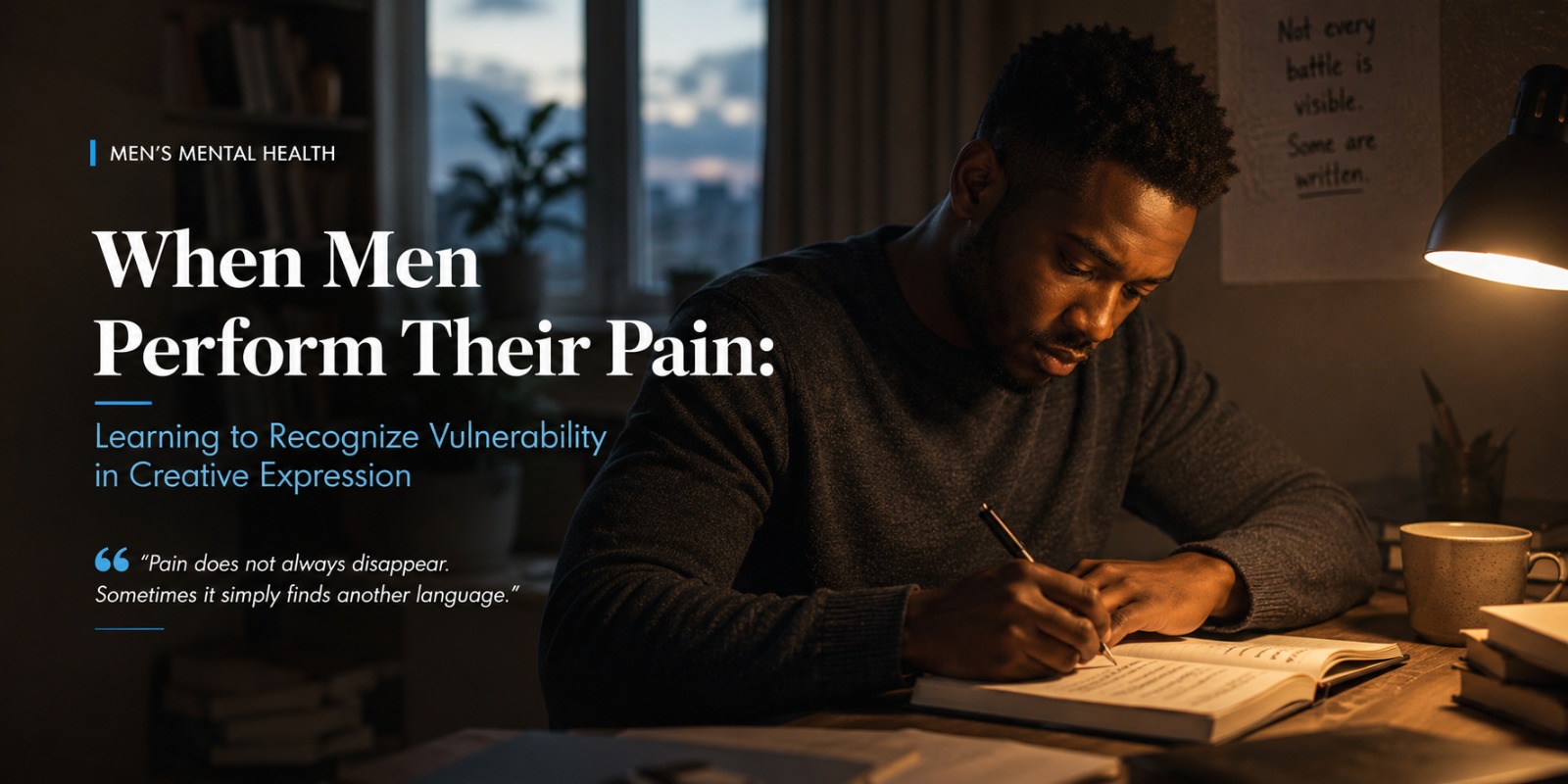
We've all been taught how to speak. We've all been taught how to express our different emotions. Thanks to the education system, many Kenyan men can speak well, write well, and express themselves eloquently. But there are some things that we are not taught. We simply learn them on our own. One of them is being able to fully share something without fully sharing it.
As a man, you grow up knowing that you are not supposed to show weakness. You are not supposed to appear less masculine or lose your composure for even a minute. And that's okay. That's what many people believe a man is supposed to be.
But I think something that has been a myth for far too long is that you are not supposed to do that with every single person. You do not have to tell the world. You can just find that one person to hear you out when you are facing a demon or going through a difficult period in your life. Sometimes you do not even want to be helped because you deeply know the solution. You simply want to be heard.
Many conversations about men's mental health focus on why men do not talk. But pain does exist. Pain does not disappear because someone chooses not to talk about it. There is no way a person can wake up one day and forget what happened the next minute. Pain still exists.
Many men do not choose to share that pain directly. Because of the current laws of masculinity that many of us grew up with, many men are moving toward performing that pain instead.
What Does It Mean to Perform Pain?
I have observed that many men are learning how to share things differently. Not by crying out loud in public. Not by rushing out in vengeance. They are trying to showcase what they are really feeling inside.
Some men, not all men, move toward indirect forms of expression. They themselves know that they are not doing it only for the joy in it, but for the feeling they get from doing it. Some become very funny. Some double down on work and keep themselves busy twenty-four hours a day. Others move toward creative expression.
Musicians, writers, poets, and artists often showcase what they feel inside. That is part of what makes music powerful. A person loves a song because they feel connected to it. They feel like they are in the same state the artist was in. The artist was able to express it, and now the listener can identify with it.
My Own Story
This is personal because I am one of the people who perform their pain.
I am a writer. I chose this path because it felt easier for me to share things through writing, poems, and other forms of expression. Not because I lacked the words to say things out loud. The expression itself made me feel eased up. It allowed me to express myself without feeling judged.
After the death of my father, I felt like there was no one I could really talk to openly. I felt like the world had caved in on me. I was okay and not okay at the same time. I wanted a place where I could simply exist. I told myself that even though I could not tell everyone what I was feeling, it was not a must for me to say out loud that I was sad, overwhelmed, or frustrated.
Instead, I embodied certain characters in my writing. Those characters went through what I was going through. That allowed me to feel like I had gotten something off my chest. And it made me feel better. I am one of the people who display vulnerability through writing and poetry.
The Joker Character
I also remember the better part of high school. I was the joker. I made jokes about almost everything. Not because I always had jokes ready. It was a form of defence. Whenever emotions became too heavy for me to carry, I made everyone around me feel lighter so that I could also feel lighter. That was my way of carrying what I felt.
Why Does It Feel Safer?
For me, writing felt safer than direct communication. When I write, people can think it is the character going through something and not me.
People still see the strong version of me. I do not feel weak. I do not feel exposed. I do not carry the burden of being judged or having my personal struggles discussed by other people.
It simply feels easier. At the same time, it makes me question something. When I indirectly express what I am feeling, what do I gain at the end of it? It gives me freedom. It makes my heart lighter.
Learning to Recognize Vulnerability
What does vulnerability mean to a man who grew up knowing that he cannot cry, cannot fully express weakness, and fears being judged, becoming a burden, or being seen as less of a man?
Maybe vulnerability does not always arrive through direct statements. Maybe it arrives through a joke. Maybe it arrives through a poem. Maybe it arrives through a song. Maybe it arrives through a story. Maybe it arrives through a piece of writing.
That does not mean every joke hides pain. Not every poem is a confession. Not every song is an autobiography. Sometimes they are. Sometimes they are not. But we should always be open to listen.
When you find something interesting that someone has written, ask: What inspired that piece? What drew you to that theme? Maybe that indirect expression is an invitation. Maybe it is a welcome door into understanding what that person has been carrying.
Beyond Direct Statements
We do not always have to wait for someone to say, "I am not okay." People express themselves in different ways. The very funny person. The writer. The singer. The artist.
The person who always seems to have something creative to share. Sometimes they are simply creating. Sometimes they are expressing something deeper. The point is not to assume. The point is to remain open.